
- FIND IT -


Job searching is tough right now for many reasons. We are all experiencing new sources of change and challenge daily, some much more than others. Hiring has slowed for many companies, and yes, layoffs are happening.
That said, many companies are continuing to hire -- especially as stimulus relief comes into play -- and some companies are hiring en masse as a result of the crisis. Whether you’ve been laid off and you imminently need a new job or you’ve been job searching for some time, there is hope!
In fact many of my clients are continuing to receive job offers.
You just have to know where to look and how to focus your job search energy on the right opportunities.
Here's my take on the best ways to find who’s hiring right now:

It’s a challenging time for all right now. And when it comes to careers, it’s an especially hard time for those who have lost jobs or income due to the coronavirus, those who were job searching when the situation began, and those who are currently sick or homebound while looking for work.
That said, there are ways to continue advancing your job search and your career right now, no matter your situation.
Companies are still hiring, and even if you’re not actively job searching, now could be a meaningful time to prepare yourself for what comes next (if you have the time and space to do so).
Keep reading for my tips for how to navigate job searching and career planning during this tough time.


Over the holidays I rewatched one of my favorite-of-all-time movies, and quickly realized that I had to recommend it to my community of Next Steppers.
The film is Julie & Julia: The story of career-deflated Julie Powell (played by Amy Adams), who is stuck in a job she hates and finds a creative way to pursue what she loves -- FOOD. Intertwined with Julie’s story is the real unfolding of the life and career of Julia Child (played by Meryl Streep), who didn’t start cooking until her 30’s and went on to become one of the most celebrated chefs of all time.
There are two reasons this movie is a must-watch assignment from your loving career coach:
You will be INSPIRED to create a career you love. You will laugh, you’ll tear up, and you’ll feel more optimistic and motivated about the possibilities for your future.
You will learn HOW to create a career you love. Because both Julie and Julia’s stories showcase the exact ingredients required to make a meaningful career change.
What are those ingredients? Allow me to break them down for you…

Dear Liz,
I’ve been thinking for a long time about transitioning out of my current career path, but am not sure where to start. Any advice on how to go through this process?
Sincerely,
Stuck At Square One
***
Dear Stuck At Square One:
Switching careers can feel like a daunting challenge, and I commend you for reaching out proactively to get a road map for going through this process.
I’ve worked with many clients navigating mid-career transitions, and while it’s not an easy task (let’s be honest, you’re talking about making a major change in your life!), it is absolutely possible -- especially when you embark upon it in a strategic and thoughtful way. And if you go through this process the right way, I promise you’ll feel that much more empowered, capable, and at ease as you move forward.



It’s important to set audacious goals for the future. If we don’t say our dreams out loud, they will never come true.
That said, sometimes we can have an unhealthy relationship with goals -- choosing goals that make us feel smaller instead of empowered, setting goals that we feel we “should” achieve instead of goals we want to achieve, or holding onto goals that are no longer right for us.
How do we choose the right goals for us?
SMART goal setting is an excellent framework for short-term goals and project management.
But for long-term goal setting (“I want to be in ________ job by 2020” or “By the end of this year I will be ________”), here are the three guiding principles I suggest keeping in mind:

The new year presents such a timely opportunity to ask ourselves, “What’s missing?” and, “What’s possible?” in our careers.
And if a new job is something you’ve set your sights on for this year, here are the top 5 strategies I recommend for landing a job you love.

When considering the financial implications of a new job or career path, most professionals immediately focus on salary.
Yet while salary is important, it’s not the whole picture.
Your next career move presents a much greater opportunity: to get your financial house in order and to make that sure your new job aligns with your financial - and life - goals.
This week, I sat down with my good friend, Emily Zeigler, CFP and Co-Founder of How Green Is Your Money. I love her simple, actionable financial advice and wanted to share some top takeaways for career shifters here.

Dear Liz,
I’m considering going back to school for my Master’s Degree (possibly an MBA). I don’t know exactly what I want to do, but I think graduate school will open a lot of doors and help me figure out which one I want to walk through. I know I’ll learn a lot, have fun being a student again, and build my network too, which can only mean good things, right?
I’m wondering, is graduate school worth it? Should I just take the leap, or how do I decide?
Sincerely,
Mulling-a-Masters

Most of us hesitate to share our deepest, most inspired career desires out loud.
It makes sense. Sharing what we want is risky.
We risk failure: “What if I tell someone I want to be X, and then it never works out? I’ll feel like a total flop.”
We risk rejection: “What if I say it out loud and people laugh, or tell me it’s not possible or that I’m not good enough?”
We risk our identity: “Everyone knows me as X. So I’d better be 100% sure of what I want before I start telling people about it.”
We risk our time and energy: “Once I say it out loud, it would sure take a lot of work to follow through and make it happen…”
But for all this risk, the bigger risk is NOT sharing our dreams. Because only once you share a dream out loud can the universe start conspiring to help you achieve it.

Most people don’t know what exactly they want to do with their careers. Even among leaders at Harvard Business School, fewer than 20% report having a strong sense of their career purpose.
Yet the perspective I consistently hear from job seekers (and that I have been pressured to feel in my own career) is that we are all born with one innate career purpose. And that if we just look hard enough or in the right places, we will find it. And that once we find it, we will be happy in our careers for all eternity.
This is quite simply the worst career advice out there. It’s not reflected in the numbers. It’s certainly not empowering to the 80% of us who don’t have that one career goal in mind. And most importantly, it’s not grounded in the reality that we are constantly changing people in a constantly changing world.
A metaphor I like to use for all the “innate purpose” and “follow your passion” advice is Michelangelo’s David.

The goal of my work is to get people inspired to dream big about their careers, and to help them follow the step-by-step path to landing their dream job.
But I must confess that the biggest mind-shift most of my clients experience while working with me or participating in my Land Your Dream Job course is this:
We achieve happiness in our careers not when we ‘get it all’, but rather when we recognize what’s most important to us, and optimize for that.
Every day I speak with professionals eager to find happiness at work. And I ask everyone the same first question: “What does happiness at work mean to you; what does it look like?”
If you’re like most people, your response goes something like this:

To stay or not to stay. Is that the question?
Oftentimes professionals fall into the trap of viewing finding a new job as an all-or-nothing decision: “Either I stick with the status quo, or I try for something better. What to do?”
Sadly, framing the question in this way leads to indecision that can drag on months or even years, because we’re searching for perfect clarity (or waiting for a perfect gig to fall in our lap) before we take action.
But you can’t think or wait your way out of career indecision. It just doesn’t work. It takes more action -- and less thinking -- to either land that next job or come to a place of peace in your current one.
What you should be asking yourself is, “What small action could I take today to move my career in the right direction?”

I’ve read more articles than I can count sharing ideas for reviving a stagnant job search. And I feel beyond frustrated every time I see suggestions like “Attend a networking event!” “Call your mentor!” and “Update that resume!”
Succeeding in the modern day job search requires a strategic approach. So when you start to feel stuck (most job seekers experience this at least once in their search), don't just try anything and everything.
Instead, pursue only the activities that address your specific challenges -- thereby saving you time and generating the results you need to move forward.
Learn the two-step process I use with job seekers who find themselves in a job search rut.

Once you’ve identified the career paths you’re most passionate about pursuing, it’s important to check in and ask yourself honestly, how hard do you want your job search to be?
My personal philosophy that I share with my clients is that I sincerely believe you can achieve just about any career path -- if you’re willing to do what it takes to get there.
But before you dive into your search, it’s helpful to have a clear understanding of how well your experience and expertise to-date position you to achieve your career goals, and to be honest with yourself about which type of transition you’re willing to take on.
First, you need to recognize that employers generally look for three areas of expertise for any job:

To figure out which job you want to do, you need to start with what you like to do.
This means asking yourself which activities and processes you want to fill your days doing -- or in other words, which skills you most enjoy.
The problem is, most of us are terrible at articulating our skills.
And if we can’t articulate our skills, how on earth can we determine which of them we enjoy most?
I see this problem frequently when my clients complete our direction-setting diagnostic. One question asks you to list all of your skills, and then categorize them into those you enjoy and don’t enjoy. With a full picture of what you can do and what you enjoy doing in front of you, it becomes easier to assess the career possibilities at your fingertips, and which of them may merit pursuit.
But when listing their skills, most people (no matter their industry!) tend to only include non-specific, soft skills like problem-solving, teamwork, communication, organizing, planning, collaborating.
This isn’t too surprising; we're socialized at work to focus on “we” over “I” and to talk in least common denominators about company and team goals -- we rarely delve into the specific parts of the process we individually own to help achieve those goals.
Yet because soft skills are applicable to most any job, they don’t help you discern which jobs you’re more likely to love than others.
For that level of insight, you need to go deeper into what I like to call “how skills.”

The vast majority of professionals cite “purpose” as one of their top priorities at work.* Yet, even among executives and students at Harvard Business School, fewer than 20% report having a strong sense of their own individual purpose.** In sum, purpose is something most of professionals want, badly, but few of them have found -- and sadly, not having found it often leaves them feeling lacking, behind, or lost.
Yes, there are hallmarked examples of individuals finding their life’s work in the blink of an eye, like Newton with his apple or Edison with his light bulb. But recent research has shed light on how creativity and insight are generated via exploration, learning and action, rather than waiting for lightning to strike.***
So here are the two simple steps we’ve found that anyone can take -- today -- to find purpose at work:
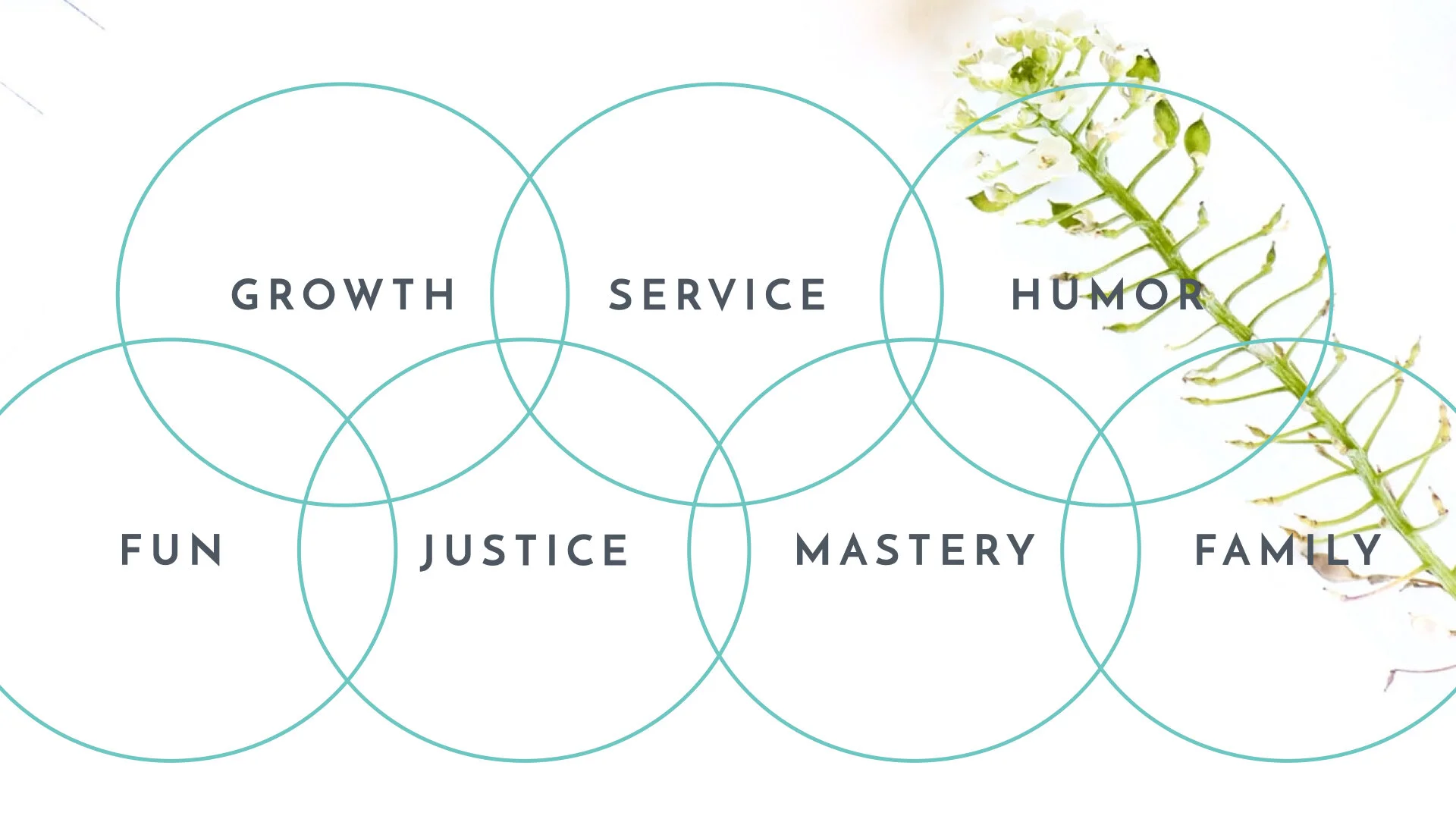
Identifying your values is an important step in understanding what motivates you in and out of the office.
- On the chart below, circle the top 15 values of most importance to you out of the 150 values listed
- Once you have your top 15, strike 5 from your list to find your top 10
- Once you have your top 10, strike 3 more from your list to find your top 7
- Now rank your top 7 values from most to least important. This will help you evaluate potential opportunities and how to take the right step in the face of challenging decisions in the future.
Once you have completed this exercise, you can move on to our career direction diagnostic to help you define your purpose at work.
- LAND IT -
NETWORKING

By taking a more proactive approach and staying connected to your network over time:
You show people that you care about them, not just because of what they can do for you. You create a genuine, reciprocal relationship that’s grounded by more than transactional requests.
You stay top of mind, so that people in your network think of you when new ideas or opportunities arise;
You lead by example, inspiring others in your professional community to act with support, care, and connectedness.
And yes, you increase the likelihood someone will say “yes” to helping you, too!
The great news is, it doesn’t take hours of time, a recurring calendar invite, or a 1,000-line Excel spreadsheet to make it happen. It just takes a few simple practices that you can start integrating into your work day today.

“What’s your anxiety right now on a scale from 1-10?” I asked him.
“I’d give it a six...” Jason replied nervously.
We had arrived at the part of the job search that makes everyone uneasy: networking. And Jason was especially unexcited about being there.

Dear Liz,
I’ve been trying to contact recruiters in my job search, but I’m not getting anywhere. I had assumed their role was all about helping people like me, but it seems like agencies just put you on their books and never offer you anything - you are just a number.
Am I going about this all wrong? How can I get recruiters to actually pay attention to me and help me find a job?
Sincerely,
Recruiter-Hungry

The job search often feels like a black box -- you have no idea which inputs actually get noticed and make a difference in getting you that job offer.
But while the complex process of applying, networking and interviewing for jobs does require a strategic approach, I'm happy to share my four favorite phrases that quickly cut through the noise and dramatically improve my clients’ job search results.
In this article I share the four phrases -- and more importantly, the mindsets beneath them -- that drive not only job search success, but career success.

One of the biggest mistakes job seekers (and all professionals) make is waiting to engage with their network until they need something.
Although we know we should “always be networking,” most professionals avoid networking because it feels time consuming, scary, and inauthentic.
But there’s a quick, easy and genuine networking activity you can do from your desk that improves your relationships, dramatically alters your career opportunities, and makes the world a better place.

Most people struggle with networking because of what I call the “scary-slimy-useless” trio:
- Networking can feel scary -- like you’re willingly putting yourself at risk of rejection or feeling like an imposter.
- Networking can feel slimy -- like you’re disingenuously using people to get what you want.
- Networking can feel useless -- like no matter how many events or coffee dates you attend, you’re still not making progress.
But by changing your mindset and approach, you can transform the way you feel about networking and the results you see from it.

If you’re just starting out in your job search, you may have spent time clicking around and applying to jobs online (nine out of ten early-stage job seekers tell me this). If so, take a moment to celebrate; shifting from thinking to action is the most challenging step in any endeavor.
But now let me level with you:
Successful job seekers focus on spending more time with people -- and less with postings.
In a complex, quickly-shifting job market with overwhelming options, you need peopleto give you context and guidance on where to focus your job search energy -- which positions to pursue, how to pursue them, and who can help you land them.
I know, I’ve said it countless times, and I’ll say it again: 85% of jobs are landed through networking. Yes, it requires picking up the phone and putting yourself out there. But the positive effects are staggering. I’ve seen languishing, months-old applications turn into interviews the same day an outreach email was sent to the right person, and I’ve seen informal interviews turn into on-the-spot job offers for positions that weren’t even posted.
And not only are the results of networking fast-acting and illuminating; as daunting as reaching out for help may seem, people have a magical way of injecting confidence and momentum into your search (both of which are hard to generate on your own).
Hence, what every early-stage job seeker needs most is a short and sweet plan for connecting with real people who can point you in the right direction and help you set your search up for success.
Read the full article for your five-step, human-centered, job search startup plan

I firmly believe that Stanford Professor Carol Dweck’s research on the growth mindset can positively impact all aspects of our personal and professional lives, which is why I share a 2-page summary of Dweck’s book with all of my clients.
For those of you who aren’t familiar with Dweck’s research, here’s the 2-bullet summary:
- Dweck shows that with the growth mindset, you can train your mind to approach challenges with wonder, excitement and resilience.
- In contrast, the fixed mindset carries the detrimental effect of making us react to challenges with fear or avoidance, hence diminishing our potential to grow.
When I was working in Silicon Valley, I heard “growth mindset” used often in meetings about hitting goals or shifting directions. But to me, job seekers are the audience that can most benefit from Dweck’s findings. Because every phase of today’s job search process requires us to face rejection and a host of other challenges, the growth mindset is almost required for getting the job. And quite simply, it can make it a whole lot more fun.
Keep reading for the five reasons the growth mindset seeker lands the job -- and how to put those tenets into action yourself.

So you’re moving forward in your search, but you feel like you’ve tapped your existing network for support and introductions. With the knowledge that 85% of jobs are landed through networking, what else can you do to position yourself for success?
You got it: more networking (I know, queue agonizing scream...).
There are many reasons why people don’t like reaching out to someone they don’t know: It’s uncomfortable. It’s scary. It may result in silence or rejection.
But here’s why you should: There is nothing to lose, and a whole lot to gain -- an introduction, an interview, or a job offer -- if you do it right.
My clients who use this template see 60-70% of people they reach out to responding positively. Pause and think about that for a second: From your desk, you could send 10 brief emails and make 6-7 new connections, and then wow them with your dynamite informational interview skills. That’s 6-7 new advocates to help you succeed in your search.
So how do you do it?
The goal is to show this person you don’t know that, in fact, you’re already connected.
You want to show that through some shared experience, passion, or aspect of your identities, you are not strangers, but allies. As a stranger, you are easy to ignore amidst the busy working day and inbox overflow. But as an ally, you are someone worth making time for -- especially when you show her that you will use her precious time wisely and create value for her in return.
Take a look at our template and steps to craft your perfect cold email. It shouldn’t take more than 20 minutes to write once you master the technique.

So you’ve figured out who you want to speak with to move forward in your job search, and you’re getting ready for an informational interview.
What would make this conversation a success?
Some people mistakenly think informational interviews are informal and all about relationship-building. But the real opportunity in an informational interview is to convince someone to become your advocate, by getting you an interview or another introduction in the right direction.
A 2016 survey revealed that 85% of jobs are found via networking, and experts tend to agree that only 30% of all jobs are posted online. Master the informational interview, and this can become the key to landing your next gig.
Here's how to convince someone you’re worthy of a little effort and a little risk, by making sure they leave your conversation thinking:
- “He knows what he wants.”
- “He came prepared with reasonable expectations.”
- “I know exactly how to help him.”
- “I want to help him.”
APPLYING

Dear Liz,
I’ve been job hunting for four months. Which kills me, because three months ago, I was told I had a job offer on the way. After a promising conversation with a VP at [a telecommunications company], I was told I was a perfect fit for a new role being created. I spent three months interviewing and waiting on budget approval. The day before I was supposed to receive my official offer, the company instituted a hiring freeze and my role came off the table.
Now here I am, four months unemployed, and completely down on my prospects. I didn’t apply for any other jobs while I was interviewing because I had been practically promised this role would come through, so I have zero other interviews lined up, and the gap on my resume now feels too big to overcome. Why did this go so wrong? And where do I go from here?
Sincerely,
Back To Square One
Dear Back To Square One:
Every day I hear similar stories -- of job seekers waiting weeks and even months to hear back from prospective employers.
And I know how it can feel to look at your calendar and think you should be further along; that sense of frustration and even panic that comes from having ‘nothing’ to show for your months of job hunting.
To help you get through this (and yes, you will get through this), or any job search problem for that matter, I always have two responses.

Every day I see job seekers with LinkedIn headlines or even resume summaries that start out like this:
Seeking opportunities…
Unemployed…
In between jobs…
In fact, almost 1 million LinkedIn members are using these headlines to try and land their next gig right now.
But this approach is a huge mistake for two very important reasons:

While phenomenal resume tips (and debates) abound, there’s one point everyone seems to miss:
Out of all the job search activities, crafting a perfect resume is the least likely to land you an interview; the odds are simply not in your favor.
You see evidence of the disadvantageous resume odds every time you apply for a position online. For example, one of my clients this past week wanted to apply for an HR Generalist position in Chicago that had been live for three days and had already received 649 applications.
On top of this, we know that recruiters spend on average 6.25 seconds reviewing a resume (if at all), and 80% of that time is spent on your name, and the company name, position title and date range of your two most recent positions -- all things you cannot change.
The takeaway: spend less time on your resume
Think of The Hunger Games. Those in power offered contestants false hope with the phrase, “May the odds be ever in your favor.” While most of the contestants rehearsed their fighting skills to marginally increase their chances, Katniss’ winning approach was to ignore conventional wisdom -- she changed the rules of the game instead.
If you’re still focusing the majority of your job search time on your resume, cover letter, and applying online, it’s time for you to rethink the rules of the job search game.
It’s not that you don’t need these resources; you still do (sorry!). But this week’s article shows you how to focus and complete your resume in the least amount of time so you can save the majority of your job search energy for higher value activities like strategic networking.
The key is to invest just enough time to make your resume strong enough to keep you in the running once you’ve gotten your foot in the door.
At NSC, we compiled all of the available research and advice into what we’ve found to be the highest value, safest bet, 30-minute resume creation template -- that still increases the odds of a recruiter or resume review software paying attention when you submit online.
Most importantly, your resume needs to accomplish two critical goals:

What’s the only part of the job search people hate more than networking?
Cover letters.
We already get the heebie-jeebies talking about ourselves, and now we have to spend an entire page writing about ourselves too? Yuch.
What’s more frustrating is that cover letters don’t even get you the job; they mostly keep you from getting crossed off the list of candidates while you’re landing the job through networking. But when an application calls for a cover letter, you need one, and it has to be strong.
Most candidates make two mistakes when writing cover letters. First, they spend too much time dumping all their work experience into the letter (making it an unnavigable stream of content). And second, they then spend too little time tailoring the letter to the specific opportunity (let’s be honest -- we’ve all quickly replaced the company name on a generic letter...). Sadly, both mistakes prevent you from making a clear and compelling presentation to your prospective employer.
This is why I teach my clients the template for writing dynamite cover letters in 20 minutes.
The secret to this template is that just like any interview question, the question you’re really responding to when writing a cover letter is “Why should I hire you?”
Your prospective employer doesn’t want your life story or a narrative recap of your resume. They want the top 2-3 reasons (max!), with supporting evidence, that you’re the best fit for the role. So why not just give it to them straight?
Keep reading for the step by step 20-minute process, or zip to the bottom of this article for the full plug-and-play template.

Stephanie recently received her Master’s degree in Special Education, and was applying for a full-time teaching position. She gave me permission to show you her full cover letter that follows our 20-minute template.
INTERVIEWING


First, I have to say: I am so sorry your interviewer didn’t show up today. Your frustration is 100% warranted.
Here are my top 5 tips for responding to this tricky situation.

It may sound surprising, but this is actually one of the toughest interview questions out there.
I’d go so far as to call it a trick question.
Because the reasons you're most likely thinking of sharing in the interview are almost never the ones you should.

Have you ever wondered what a GREAT response to the dreaded "What's your greatness weakness?" question sounds like?
Most people treat this question like an encounter with a hornet's nest: they freak out and then do whatever they can to get to the other side as unscathed as possible.
But not preparing your answer in advance -- or giving a response like, "I'm a perfectionist," or, "I can't really think of any weaknesses right now..." can cost you the job offer.
So today I'm releasing a brief video that takes all the guesswork out of this question..

Dear Liz,
I have an interview coming up, and my friend who works at the company keeps offering to help me practice. I know it’s really nice of him to offer, but my gut is telling me not to do it. Practicing makes me uncomfortable, and I feel like I’ll be more relaxed and authentic if I go in fresh.
Should I trust my gut, or take my friend up on his offer?
Sincerely,
Wanting-to-Wing-it
***
Dear Wanting-to-Wing-it,
I want to commend you for asking this question. Every day I speak with clients who tell me they prefer not to prepare for interviews.
Just like you, practicing makes them uncomfortable. They get this gut feeling that tells them…

Sometimes I think back to past interviews… and all I can do is put my head in my hands and shake it back and forth while I wish the embarrassing memory away. Can you relate?
One memory in particular makes me cringe every time I play it back.

Nailing the interview starts to feel a whole lot less scary once you're exceptionally prepared. And that means being prepared to tackle each of these most-common interview questions with the NSC interview response formula:
- Tell me about yourself.
- Why are you interested in working for us?
- Why are you looking for a new job / why do you want to leave your current organization?
- What are your strengths?

At some point in the interview, likely towards the end, we know we’ll be asked for our questions (it happens in 84% of interviews). And we know asking good questions is important, since 32% of hiring managers in a recent study stated not asking good questions in the interview is one of the most detrimental mistakes job candidates make.
Yet we often short-shift preparing for this inevitable moment of the interview. I hear it all the time:
“I’ll just ask about company culture, or what they like most about working at the company, or about an exciting project coming up.”
These mediocre questions may not hurt your chances of getting the job like some questions do (which I’ll be digging into next week), but they don’t help you either.
What few people realize is that great questions have the power to convince your interviewer to give you the offer -- sometimes right there in the interview room! And a handful of these great questions carry the dual benefit of eliciting information to help you determine whether you really want the job.
The “Do you have any questions for me?” moment of the interview can confuse us, because we’ve prepared for and gotten used to responding; when the table turns, we can mistakenly put ourselves in the driver’s seat and assume what we ask doesn’t matter.
And while in some cases this may be true (like when you know you’re the top pick for the job), most often you are still selling yourself during this part of the interview! Focus on questions that demonstrate your commitment and determination to helping your prospective employer be as successful as possible, and save the “me, me, me” questions for once you receive the offer.
Keep reading for our shortlist of dynamite win-win questions that get you one step closer to an offer -- and figuring out if you really want the job.

So you interviewed for a job, started to see yourself in the position and feel it within your grasp, and then didn’t get the offer. This article will share step-by-step instructions on how to get the best insight out of your rejection and increase the likelihood of getting to “yes” next time.

There must be thousands of articles on typical interview questions and how to prepare for them. Mostly, the advice tends to center around “be specific!” or “do your research!” or “make eye contact!” All good stuff. But I haven’t seen anything yet that shares the secret to interviewing, and the number one trick you can use to knock it out of the park, every time.
So here’s the secret:

A strong, positive relationship with your manager is one of the most critical components of loving your job.
You are not expected (or likely) to thrive working under any manager under the sun; all managers have different approaches to leadership, communication, defining and evaluating success, work-life balance and mentorship--as do you. Just like finding the right partner in love, fit is important.
What you are expected to do, however, is work hard during your interview process to learn as much as you can about your prospective manager in order to make the most educated guess as possible about whether you will fit and thrive working together.
Of course, you’re also half responsible for making your relationship with your manager great after you’ve accepted the job (fit doesn’t mean everything comes easy!). But that lesson is for another day. First, let’s focus on concrete steps to helping you evaluate your prospective manager before you get so excited about your offer that you forget to do your due diligence:
- What to research about your prospective manager before meeting her/him
- How to develop your question list for your in-person meeting
- Reflection questions for after your meeting
- LOVE IT -

Job Seeker Love Letter from “Reluctantly Remote”
Dear Liz,
I just accepted a job offer and will need to start working from home since everyone works remotely right now.
I suppose I will get training via Zoom or Microsoft Teams, but it's uncharted territory for me and I’m nervous about it. How does it work nowadays for new hires getting training and not being able to meet your new manager and coworkers in the office? Do you have any advice for managing this transition?
Sincerely,
Reluctantly Remote

Instead of saying, “I don’t know if I could… [land a better job / learn to code / get that promotion]...” Try this question instead.

When it comes to tough conversations in the workplace -- asking your manager about working remotely, a raise, parental leave or flexibility, a change to your job description or a deadline -- most people ruminate endlessly on the potential risks.
She could say no...
She could get mad that I’m asking...
She could FIRE me...
I could come across as entitled, or unprofessional, or lazy, and this could be the beginning of the slow death of my entire career…..!
The prospect of “making waves” ignites worry and even catastrophic thinking in the best of us.
But sometimes we become so blinded by the risks of having the conversation, we fail to see the risks of not having the conversation.

Dear Liz,
I recently started working with a new supervisor, and she’s hard to read. When I send her drafts of my writing projects (I work in online curriculum development), she returns them to me with lots of edits. I don’t mind the edits, but she hasn’t given me any qualitative feedback like “good job,” or “this should have been better.”
I’m working as hard as I can, but I’m constantly wondering whether I’m exceeding expectations, or if I’m at risk of being fired.
Should I just assume I’m doing well (and do my best to set aside my pangs of fear that I’m not) and hope for a positive 6-month review? Or what’s your advice?
Sincerely,
Reading-Between-The-Lines

Dear Liz,
I’m dreading going home for the holidays. My friends and family keep announcing their big new job titles on Facebook and LinkedIn while I’m still in the same job I’ve been in the past couple of years. I hate being asked “What’s new at work?” and “What’s next?” when I don’t have anything impressive to say.
How do I respond to these questions when I don’t have good answers? Do I just suffer through it and make next year the year I up my career game?
Sincerely,
Embarrassed To Be Asked

In the spirit of #MentalHealthAwarenessDay I’m sharing publicly for the first time my experience with panic attacks + my personal takeaways on anxiety and career success. To note, I am a career coach, not a mental health professional. If you are job searching and affected by anxiety, depression, or other mental wellness challenges (like 1/3 of the individuals in our country), I hope you will find support in a certified mental health professional in addition to a career coach -- two very different and very worthy resources!

This is the latest edition of Job Seeker Love Letters where I respond to job seekers' questions with what I like to call "tough-love and love-love."
Dear Liz,
I’ll start with the good news: I think I have a job offer coming in this week! My interviews have all gone well, and the hiring manager told me herself that she wanted to cancel the interviews with other candidates because she thinks I’m the perfect person for the job. This is my dream company and I’m jumping out of my seat I’m so excited!!!
I’ve thought about negotiating, but since this is my dream company, what’s most important to me is not blowing the offer. Should I just take what they offer, or should I try to negotiate? I’m feeling totally lost in this and would appreciate your guidance.
Sincerely,
Scared-To-Negotiate

It’s the end of the year, which means most of us are focused on getting out of the office -- and getting into our comfiest pajamas to celebrate the holidays with family and friends.
But before you turn off your office lights and drive home to the tune of Bing Crosby’s ‘Happy Holidays’ (I can hear him crooning now...), here are 3 questions I recommend asking yourself to make sure you close out the year strong and set yourself up to hit the ground running next year.

When it comes to salary negotiation, job seekers make three common mistakes:
- They fear negotiating.
- They fail to prepare early and extensively.
- They share their desired salary before receiving an official offer.
What I’ve learned from coaching clients through the job search process and through instruction from salary negotiation expert Jim Hopkinson, is that just like interviewing or any other job search activity, salary negotiation requires a confident and strategic approach.
In response to the above missteps, there are three key messages about salary negotiation I hope every job seeker keeps in mind when gearing up for their search.

So you've succeeded in navigating the long, demoralizing, painstaking process of landing a job offer. Congratulations!
Chances are the first thing you'll want to do is share the good news with family, friends and mentors -- and get their take on whether you should accept it.
But wait! Picking up the phone too soon can be a serious mistake. Why?
The only person’s values you want driving your career decisions are your own.
And until you clarify what's most important to you, it's best to avoid input from others that could muddle your decision-making process, or possibly bind you to satisfying their preferences over yours.
Keep reading to learn how to make your values the first stop in your decision-making process.

Last week we broke down why job searching should be one of everyone’s 2017 New Year’s Resolutions. But the first job search step I tell all my clients to take is to honestly assess your potential to turn your current position into one you love, before you double down on looking elsewhere.
One of the best exercises I've found for assessing challenging situations and getting moving in the right direction is The Bugs Test, which I learned from my mentor Tony Brown at Duke University.
What makes The Bugs Test so powerful is its immediate ability to provide clarity by categorizing problems into:
- the problems we can easily change,
- the problems we should accept (because they’ll never change), and
- the problems we might be able to change with serious thought and effort (hint: these are often the most important ones).
Whether you’re interested in moving on or simply making an already strong work situation even better, in 10 minutes you should have clearer insight into how to take ownership of your next steps and your future happiness at work.
Identifying your values is an important step in understanding what motivates you in and out of the office.
- On the chart below, circle the top 15 values of most importance to you out of the 150 values listed
- Once you have your top 15, strike 5 from your list to find your top 10
- Once you have your top 10, strike 3 more from your list to find your top 7
- Now rank your top 7 values from most to least important. This will help you evaluate potential opportunities and how to take the right step in the face of challenging decisions in the future.
Once you have completed this exercise, you can move on to our career direction diagnostic to help you define your purpose at work.
- MY PODCAST RECCS -

If you've been following along the past month, I've been sharing my favorite podcast episodes of all time - those which have most impacted my life and the lives of my clients.
This week's episode might just be my all-time favorite, and coincidentally also the shortest: in this 12-minute speech from the On Being Annual Gathering, poet David Whyte lays bare why it feels so darn hard to find a fulfilling career today, and what to do about it.
If you’ve been asking yourself questions like, “Why can’t this job search thing be easier?” or “Is there something better out there for me? What’s my purpose??”, this one's for you.

“We suffer more often in imagination than in reality” - Seneca
If there’s one thing I see getting in the way of people’s job search and career success more than anything else, it’s fear.
Fear is that racing in our chest, or the doubting voice deep in our minds that holds us back from taking the actions we most desire. Actions like searching for a more fulfilling career, negotiating for the raise we know we deserve, scheduling a networking conversation, quitting a job before we have a new one lined up, starting a tough conversation with our boss, or simply speaking up in meetings.
Fear says to us, “Maybe you shouldn’t…”
And sometimes that “maybe” is all it takes to send us into a state of paralysis.
There’s no way to eliminate fear from our emotional repertoire. We all feel it (I sure do!)
But we can change how we handle fear -- how we evaluate it, put it in perspective, and methodically decide which fears are worth leaning into in order to build our happiest careers and lives.

Next up in my “My favorite podcasts” sequence is an inspiring interview with author Elizabeth Gilbert, on the importance of curiosity.
I often return to this episode for Elizabeth’s perspective on why "find your passion" is bad advice, and how curiosity drives success and happiness.

Click here to listen to 23 minutes of pure joy with inspirational speaker, Iyanla Vanzant.
When I first listened to this, I spent an entire grocery shopping experience belly laughing - out loud - up and down the aisles. And if there’s one thing I’m sure of, it’s that job searching (and life!) require some heavy doses of laughter.
I also walked away with a host of messages I knew could impact my life and my clients’ lives
- BOOK SUMMARIES -

In her 2019 book, The Imposter Cure: How to stop feeling like a fraud and escape the mind-trap of imposter syndrome, clinical psychologist Dr. Jessamy Hibberd shares the three steps to overcoming imposter syndrome:
Understanding the theory
Choosing to change
Trying out new strategies and approaches

Key highlights from Parker Palmer’s short and worthy book, Let Your Life Speak, and my takeaways for today’s job seekers.

Tribe: On Homecoming & Belonging by American journalist, author and filmmaker Sebastian Junger is rich with story and fact, and I highly recommend reading it in full (~150 pages). In this brief summary, I share the main points that continue to stick with me, and how lessons from Tribe apply to today’s job seekers.

In her 2007 Book, Mindset: The New Psychology of Success, Stanford Researcher Carol Dweck shares the following research conclusions: